Filters
Question type

Study Flashcards

Swine are vulnerable to infection by bird flu virus and human flu virus, which can both be present in an individual pig at the same time. When this occurs, it is possible for genes from bird flu virus and human flu virus to be combined. If the human flu virus contributes a gene for Tamiflu resistance (Tamiflu is an antiviral drug) to the new virus, and if the new virus is introduced to an environment lacking Tamiflu, then what is most likely to occur?


A) The new virus will maintain its Tamiflu-resistance gene, just in case of future exposure to Tamiflu.
B) The Tamiflu-resistance gene will undergo mutations that convert it into a gene that has a useful function in this environment.
C) If the Tamiflu-resistance gene involves a cost, it will experience directional selection leading to reduction in its frequency.
D) If the Tamiflu-resistance gene confers no benefit in the current environment, and has no cost, the virus will become dormant until Tamiflu is present.

E) B) and C)
F) B) and D)

Correct Answer

verifed

verified

The following questions refer to the following paragraph. HIV's genome of RNA includes the code for reverse transcriptase (RT) , an enzyme that acts early in infection to synthesize a DNA genome off of an RNA template. The HIV genome also codes for protease (PR) , an enzyme that acts later in infection by cutting long viral polyproteins into smaller, functional proteins. Both RT and PR represent potential targets for antiretroviral drugs. Drugs called nucleoside analogs (NA) act against RT, whereas drugs called protease inhibitors (PI) act against PR. -Every HIV particle contains two RNA molecules. If two genes from one RNA molecule become detached and then, as a unit, get attached to one end of the other RNA molecule within a single HIV particle, which of these is true?


A) There are now fewer genes within the viral particle.
B) There are now more genes within the viral particle.
C) A point substitution mutation has occurred in the retroviral genome.
D) The retroviral equivalent of crossing over has occurred, no doubt resulting in a heightened positive effect.
E) One of the RNA molecules has experienced gene duplication as the result of translocation.

F) A) and D)
G) A) and E)

Correct Answer

verifed

verified

Considering the overall human population of the U.S. mainland at the time when the slave trade brought large numbers of people from equatorial Africa, what was primarily acting to change the frequency of the sickle-cell allele in the overall U.S. population?


A) natural selection
B) gene flow
C) genetic drift
D) founder effect
E) Two of the responses are correct.

F) A) and B)
G) None of the above

Correct Answer

verifed

verified

In the United States, the parasite that causes malaria is not present, but African-Americans whose ancestors were from equatorial Africa are present. What should be happening to the sickle-cell allele in the United States, and what should be happening to it in equatorial Africa?


A) stabilizing selection; disruptive selection
B) disruptive selection; stabilizing selection
C) disruptive selection; directional selection
D) directional selection; disruptive selection
E) directional selection; stabilizing selection

F) All of the above
G) None of the above

Correct Answer

verifed

verified

You are maintaining a small population of fruit flies in the laboratory by transferring the flies to a new culture bottle after each generation. After several generations, you notice that the viability of the flies has decreased greatly. Recognizing that small population size is likely to be linked to decreased viability, the best way to reverse this trend is to


A) cross your flies with flies from another lab.
B) reduce the number of flies that you transfer at each generation.
C) transfer only the largest flies.
D) change the temperature at which you rear the flies.
E) shock the flies with a brief treatment of heat or cold to make them more hardy.

F) B) and C)
G) A) and E)

Correct Answer

verifed

verified

You sample a population of butterflies and find that 56% are heterozygous at a particular locus. What should be the frequency of the recessive allele in this population?


A) 0.07
B) 0.08
C) 0.09
D) 0.70
E) Allele frequency cannot be determined from this information.

F) B) and D)
G) C) and D)

Correct Answer

verifed

verified

A proficient engineer can easily design skeletal structures that are more functional than those currently found in the forelimbs of such diverse mammals as horses, whales, and bats. The actual forelimbs of these mammals do not seem to be optimally arranged because


A) natural selection has not had sufficient time to create the optimal design in each case, but will do so given enough time.
B) in many cases, phenotype is not merely determined by genotype, but by the environment as well.
C) though we may not consider the fit between the current skeletal arrangements and their functions excellent, we should not doubt that natural selection ultimately produces the best design.
D) natural selection is generally limited to modifying structures that were present in previous generations and in previous species.

E) B) and D)
F) None of the above

Correct Answer

verifed

verified

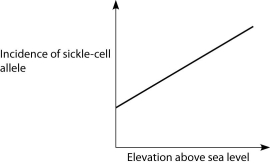
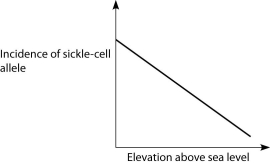
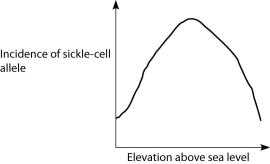
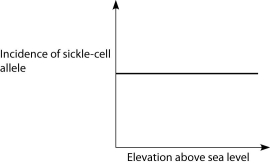
Anopheles mosquitoes, which carry the malaria parasite, cannot live above elevations of 5,900 feet. In addition, oxygen availability decreases with higher altitude. Consider a hypothetical human population that is adapted to life on the slopes of Mt. Kilimanjaro in Tanzania, a country in equatorial Africa. Mt. Kilimanjaro's base is about 2,600 feet above sea level and its peak is 19,341 feet above sea level. If the incidence of the sickle-cell allele in the population is plotted against altitude (feet above sea level) , which of the following distributions is most likely, assuming little migration of people up or down the mountain?


A) Anopheles mosquitoes, which carry the malaria parasite, cannot live above elevations of 5,900 feet. In addition, oxygen availability decreases with higher altitude. Consider a hypothetical human population that is adapted to life on the slopes of Mt. Kilimanjaro in Tanzania, a country in equatorial Africa. Mt. Kilimanjaro's base is about 2,600 feet above sea level and its peak is 19,341 feet above sea level. If the incidence of the sickle-cell allele in the population is plotted against altitude (feet above sea level) , which of the following distributions is most likely, assuming little migration of people up or down the mountain? A)    B)    C)    D)
B) Anopheles mosquitoes, which carry the malaria parasite, cannot live above elevations of 5,900 feet. In addition, oxygen availability decreases with higher altitude. Consider a hypothetical human population that is adapted to life on the slopes of Mt. Kilimanjaro in Tanzania, a country in equatorial Africa. Mt. Kilimanjaro's base is about 2,600 feet above sea level and its peak is 19,341 feet above sea level. If the incidence of the sickle-cell allele in the population is plotted against altitude (feet above sea level) , which of the following distributions is most likely, assuming little migration of people up or down the mountain? A)    B)    C)    D)
C) Anopheles mosquitoes, which carry the malaria parasite, cannot live above elevations of 5,900 feet. In addition, oxygen availability decreases with higher altitude. Consider a hypothetical human population that is adapted to life on the slopes of Mt. Kilimanjaro in Tanzania, a country in equatorial Africa. Mt. Kilimanjaro's base is about 2,600 feet above sea level and its peak is 19,341 feet above sea level. If the incidence of the sickle-cell allele in the population is plotted against altitude (feet above sea level) , which of the following distributions is most likely, assuming little migration of people up or down the mountain? A)    B)    C)    D)
D) Anopheles mosquitoes, which carry the malaria parasite, cannot live above elevations of 5,900 feet. In addition, oxygen availability decreases with higher altitude. Consider a hypothetical human population that is adapted to life on the slopes of Mt. Kilimanjaro in Tanzania, a country in equatorial Africa. Mt. Kilimanjaro's base is about 2,600 feet above sea level and its peak is 19,341 feet above sea level. If the incidence of the sickle-cell allele in the population is plotted against altitude (feet above sea level) , which of the following distributions is most likely, assuming little migration of people up or down the mountain? A)    B)    C)    D)

E) All of the above
F) A) and B)

Correct Answer

verifed

verified

There are 40 individuals in population 1, all with genotype A1A1, and there are 25 individuals in population 2, all with genotype A2A2. Assume that these populations are located far from each other and that their environmental conditions are very similar. Based on the information given here, the observed genetic variation is most likely an example of


A) genetic drift.
B) gene flow.
C) disruptive selection.
D) discrete variation.
E) directional selection.

F) C) and E)
G) A) and E)

Correct Answer

verifed

verified

A

Use this information to answer the following questions. You are studying three populations of birds. Population A has ten birds, of which one is brown (a recessive trait) and nine are red. Population B has 100 birds, of which ten are brown. Population C has 30 birds, and three of them are brown. -In which population would it be least likely that an accident would significantly alter the frequency of the brown allele?


A) population A
B) population B
C) population C
D) They are all the same.
E) It is impossible to tell from the information given.

F) A) and E)
G) A) and D)

Correct Answer

verifed

verified

Which statement about variation is true?


A) All phenotypic variation is the result of genotypic variation.
B) All genetic variation produces phenotypic variation.
C) All nucleotide variability results in neutral variation.
D) All new alleles are the result of nucleotide variability.
E) All geographic variation results from the existence of clines.

F) All of the above
G) A) and D)

Correct Answer

verifed

verified

In a hypothetical population's gene pool, an autosomal gene, which had previously been fixed, undergoes a mutation that introduces a new allele, one inherited according to incomplete dominance. Natural selection then causes stabilizing selection at this locus. Consequently, what should happen over the course of many generations?


A) The proportions of both types of homozygote should decrease.
B) The proportion of the population that is heterozygous at this locus should remain constant.
C) The population's average heterozygosity should decrease.
D) The two homozygotes should decrease at different rates.

E) B) and C)
F) None of the above

Correct Answer

verifed

verified

A

Use this information to answer the following questions. A large population of laboratory animals has been allowed to breed randomly for a number of generations. After several generations, 25% of the animals display a recessive trait (aa) , the same percentage as at the beginning of the breeding program. The rest of the animals show the dominant phenotype, with heterozygotes indistinguishable from the homozygous dominants. -What proportion of the population is probably heterozygous (Aa) for this trait?


A) 0.05
B) 0.25
C) 0.50
D) 0.75

E) All of the above
F) A) and D)

Correct Answer

verifed

verified

Hardy-Weinberg equilibrium must occur in populations wherein


A) an allele remains fixed.
B) no genetic variation exists.
C) natural selection is not operating.
D) All three of the responses above are correct.
E) Only two of the responses above are correct.

F) B) and D)
G) C) and D)

Correct Answer

verifed

verified

Sexual dimorphism is most often a result of


A) pansexual selection.
B) stabilizing selection.
C) intrasexual selection.
D) intersexual selection.
E) artificial selection.

F) D) and E)
G) B) and C)

Correct Answer

verifed

verified

Although each of the following has a better chance of influencing gene frequencies in small populations than in large populations, which one most consistently requires a small population as a precondition for its occurrence?


A) mutation
B) nonrandom mating
C) genetic drift
D) natural selection
E) gene flow

F) C) and E)
G) B) and D)

Correct Answer

verifed

verified

Most Swiss starlings produce four to five eggs in each clutch. Starlings producing fewer, or more, than this have reduced fitness. Which of the following terms best describes this situation?


A) artificial selection
B) directional selection
C) stabilizing selection
D) disruptive selection
E) sexual selection

F) B) and E)
G) A) and B)

Correct Answer

verifed

verified

The following questions refer to the following paragraph. HIV's genome of RNA includes the code for reverse transcriptase (RT) , an enzyme that acts early in infection to synthesize a DNA genome off of an RNA template. The HIV genome also codes for protease (PR) , an enzyme that acts later in infection by cutting long viral polyproteins into smaller, functional proteins. Both RT and PR represent potential targets for antiretroviral drugs. Drugs called nucleoside analogs (NA) act against RT, whereas drugs called protease inhibitors (PI) act against PR. -Within the body of an HIV-infected individual who is being treated with a single NA, and whose HIV particles are currently vulnerable to this NA, which of these situations can increase the virus' relative fitness? 1) mutations resulting in RTs with decreased rates of nucleotide mismatch 2) mutations resulting in RTs with increased rates of nucleotide mismatch 3) mutations resulting in RTs that have proofreading capability


A) 1 only
B) 2 only
C) 3 only
D) 1 and 3
E) 2 and 3

F) D) and E)
G) A) and B)

Correct Answer

verifed

verified

Whenever diploid populations are in Hardy-Weinberg equilibrium at a particular locus


A) the allele's frequency should not change from one generation to the next, but its representation in homozygous and heterozygous genotypes may change.
B) natural selection, gene flow, and genetic drift are acting equally to change an allele's frequency.
C) this means that, at this locus, two alleles are present in equal proportions.
D) the population itself is not evolving, but individuals within the population may be evolving.

E) A) and C)
F) None of the above

Correct Answer

verifed

verified

A

In the formula for determining a population's genotype frequencies, the 2 in the term 2pq is necessary because


A) the population is diploid.
B) heterozygotes can come about in two ways.
C) the population is doubling in number.
D) heterozygotes have two alleles.

E) A) and D)
F) B) and C)

Correct Answer

verifed

verified

Showing 1 - 20 of 78

Related Exams

Show Answer